

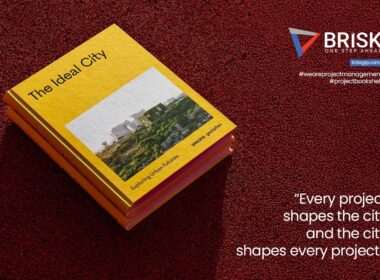

A review of Space10 & Gestalten’s The Ideal City: Exploring Urban Futures
What if the future of project management isn’t just about delivering buildings — but about shaping the metabolism of the cities they belong to?
This is the central insight behind The Ideal City, a forward-thinking book created by Space10 (IKEA’s global innovation lab) and Gestalten.
It’s not a book about architecture in the traditional sense. It’s a manifesto for how cities can become more resilient, human-centered, low-carbon, and adaptive — and what the built environment must become to support that transformation.
For anyone working in construction, urban development, or project delivery, it’s essential reading.
Cities Are Not Just Places. They Are Systems.
The Ideal City argues that the next generation of urban projects needs to respond not only to design briefs, but to:
- demographic patterns,
- energy flows,
- mobility networks,
- social needs,
- environmental pressures,
- and economic transitions.
In other words: every project is simultaneously a building and a node.
A node in a human system, a material system, a mobility system, and — increasingly — a climate system.
This is the kind of thinking that project managers and consultants in 2025 need to internalize:
Deliverables don’t exist in isolation. They exist in ecosystems.
Five Principles the Book Brings to Life — and Why They Matter to PMs
- Adaptability Over Permanence
Cities change faster than buildings. Projects must be designed for flexibility: modularity, transformable spaces, mixed uses.
For PMs, this means managing uncertainty with intention, not fear. - Human-Centered Design
Buildings that ignore user behaviour fail — even if they’re technically “sustainable”.
The book reinforces the importance of post-occupancy logic in early design decisions. - Material Intelligence
Regenerative materials, circularity, low-carbon solutions — not as buzzwords, but as strategic constraints.
The project manager becomes a curator of choices, not just a coordinator of tasks. - Smarter Public Space and Mobility
Projects shape mobility flows. Mobility flows shape cities.
Understanding how an asset interacts with transport, pedestrians, logistics or community behaviours becomes part of the PM’s due diligence. - Scalability of Good Ideas
Small interventions can have city-wide impact if scaled strategically.
Good PMs know how to replicate successful models across portfolios, regions, and asset classes.
Why This Book Matters to Brisk Group
Brisk delivers projects that sit at the intersection of design, engineering, sustainability, and urban logic — from hospitals and logistics hubs to retail ecosystems and residential developments.
The questions raised in The Ideal City align directly with the challenges we face daily:
- How does a new development reshape mobility patterns?
- How do we integrate sustainability without inflating cost?
- How do we ensure that user experience informs design, not the other way around?
- How do we deliver projects that stand the test of time — socially, environmentally, and financially?
Our approach already integrates this mindset: systems thinking, lifecycle logic, clarity in design coordination, and responsibility toward the broader urban fabric.
But this book helps articulate the shift underway in global construction:
from building objects to building relationships — between people, spaces, ecosystems, and the city.
Final Thought
The Ideal City is not just inspiration. It’s a framework.
It’s a reminder that the future of project management belongs to those who understand cities not as backgrounds, but as clients.
📘 We recommend this book to every PM, designer, engineer, developer and public official who wants to build responsibly — and intelligently — for the next urban era.


